CBSE Class 10 Science Notes Chapter 1 Chemical Reactions and Equations
CBSE Class 10 Science Notes Chapter 1 Chemical Reactions and Equations
What is a chemical reaction ?
Chemical Reaction: The transformation of chemical substance into another chemical substance is known as Chemical Reaction. For example: Rusting of iron, the setting of milk into curd, digestion of food, respiration, etc.
In a chemical reaction, a new substance is formed which is completely different in properties from the original substance, so in a chemical reaction, a chemical change takes place.
Only a rearrangement of atoms takes place in a chemical reaction.
- The substances which take part in a chemical reaction are called reactants.
- The new substances produced as a result of a chemical reaction are called products.

Mg(s) + O2(g) 
Before burning in air, the magnesium ribbon is cleaned by rubbing with sandpaper.
This is done to remove the protective layer of basic magnesium carbonate from the surface of the magnesium ribbon.
Reactant: Substances which take part in a chemical reaction are called reactants.
Example: Mg and O2.
Product: New substance formed after a chemical reaction is called a product.
Example: MgO.
Characteristics of Chemical Reactions :
(i) Evolution of gas: The chemical reaction between zinc and dilute sulphuric acid is characterised by the evolution of hydrogen gas.
Zn(s) + H2SO4(aq) → ZnSO4(aq) + H2(g) ↑
(ii) Change in Colour: The chemical reaction between citric acid and purple coloured potassium permanganate solution is characterised by a change in colour from purple to colourless.
The chemical reaction between sulphur dioxide gas and acidified potassium dichromate solution is characterized by a change in colour from orange to green.
(iii) Change in state of substance: The combustion reaction of candle wax is characterised by a change in state from solid to liquid and gas (because the wax is a solid, water formed by the combustion of wax is a liquid at room temperature whereas, carbon dioxide produced by the combustion of wax is a gas). There are some chemical reactions which can show more than one characteristics.
(iv) Change in temperature: The chemical reaction between quick lime water to form slaked lime is characterized by a change in temperature (which is a rise in temperature).
The chemical reaction between zinc granules and dilute sulphuric acid is also characterised by a change in temperature (which is a rise in temperature).
(v) Formation of precipitate: The chemical reaction between sulphuric acid and barium chloride solution is characterised by the formation of a white precipitate of barium sulphate.
BaCl2(aq) + H2SO4(aq) → BaSO4(s) (ppt) + 2HCl(aq)
Chemical Equation
The symbolic representation of chemical reaction using symbols and formulae is known as Chemical Equation. For this, reactants are written in left hand side whereas products are written on the right.
The symbolic representation of chemical reaction using symbols and formulae is known as Chemical Equation. For this, reactants are written in left hand side whereas products are written on the right.
Word equation
A  word equation is a chemical reaction expressed in words rather than chemical formulas. It helps identify the reactants and products in a chemical reaction.
For example,
Sodium + Chlorine → Sodium chloride
The above equation means: “Sodium reacts with chlorine to form sodium chloride.”
A word equation is a chemical reaction expressed in words rather than chemical formulas. It helps identify the reactants and products in a chemical reaction.
For example,
Sodium + Chlorine → Sodium chloride
The above equation means: “Sodium reacts with chlorine to form sodium chloride.”
Symbols of elements and their valencies
A symbol is the chemical code for an element. Each element has one or two-letter atomic symbol, which is the abbreviated form of its name.
Valency is the combining capacity of an element. It can be considered as the number of electrons lost, gain or shared by an atom when it combines with another atom to form a molecule.
A symbol is the chemical code for an element. Each element has one or two-letter atomic symbol, which is the abbreviated form of its name.
Valency is the combining capacity of an element. It can be considered as the number of electrons lost, gain or shared by an atom when it combines with another atom to form a molecule.
Writing chemical equations
Representation of a chemical reaction in terms of symbols and chemical formulae of the reactants and products is known as a chemical equation.

• For solids, the symbol is “(s)”.
• For liquids, it is “(l)”.
• For gases, it is “(g)”.
• For aqueous solutions, it is “(aq)”.
• For gas produced in the reaction, it is represented by “(↑)”.
• For precipitate formed in the reaction, it is represented by “(↓)”.
Balanced Chemical Equation: A balanced chemical equation has the number of atoms of each element equal on both sides.
Example: Zn + H2SO4 → ZnSO4 + H2
In this equation, numbers of zinc, hydrogen and sulphate are equal on both sides, so it is a Balanced Chemical Equation.
According to the Law of Conservation of Mass, mass can neither be created nor destroyed in a chemical reaction. To obey this law, the total mass of elements present in reactants must be equal to the total mass of elements present in products.
Representation of a chemical reaction in terms of symbols and chemical formulae of the reactants and products is known as a chemical equation.
• For solids, the symbol is “(s)”.
• For liquids, it is “(l)”.
• For gases, it is “(g)”.
• For aqueous solutions, it is “(aq)”.
• For gas produced in the reaction, it is represented by “(↑)”.
• For precipitate formed in the reaction, it is represented by “(↓)”.
Balanced Chemical Equation: A balanced chemical equation has the number of atoms of each element equal on both sides.
Example: Zn + H2SO4 → ZnSO4 + H2
In this equation, numbers of zinc, hydrogen and sulphate are equal on both sides, so it is a Balanced Chemical Equation.
According to the Law of Conservation of Mass, mass can neither be created nor destroyed in a chemical reaction. To obey this law, the total mass of elements present in reactants must be equal to the total mass of elements present in products.
Balancing of a Chemical Reaction
Conservation of mass
According to the law of conservation of mass, no atoms can be created or destroyed in a chemical reaction, so the number of atoms for each element in the reactants side has to balance the number of atoms that are present in the products side.
In other words, the total mass of the products formed in a chemical reaction is equal to the total mass of the reactants participated in a chemical reaction.
According to the law of conservation of mass, no atoms can be created or destroyed in a chemical reaction, so the number of atoms for each element in the reactants side has to balance the number of atoms that are present in the products side.
In other words, the total mass of the products formed in a chemical reaction is equal to the total mass of the reactants participated in a chemical reaction.
Balanced chemical equation
The chemical equation in which the number of atoms of each element in the reactants side is equal to that of the products side is called a balanced chemical equation.
The chemical equation in which the number of atoms of each element in the reactants side is equal to that of the products side is called a balanced chemical equation.
Steps for balancing chemical equations
Hit and trial method: While balancing the equation, change the coefficients (the numbers in front of the compound or molecule) so that the number of atoms of each element is same on each side of the chemical equation.
Hit and trial method: While balancing the equation, change the coefficients (the numbers in front of the compound or molecule) so that the number of atoms of each element is same on each side of the chemical equation.
Short-cut technique for balancing a chemical equation
Example:
aCaCO3 + bH3PO4 → cCa3(PO4)2 + dH2CO3
Set up a series of simultaneous equations, one for each element.
Ca: a=3c
C: a=d
O: 3a+4b=8c+3d
H: 3b=2d
P: b=2c
Let’s set c=1
Then a=3 and
d = a = 3
b = 2c = 2
So a=3; b=2; c=1; d=3
The balanced equation is
3CaCO3 + 2H3PO4 → Ca3 (PO4)2 + 3H2CO3
Example:
aCaCO3 + bH3PO4 → cCa3(PO4)2 + dH2CO3
Set up a series of simultaneous equations, one for each element.
Ca: a=3c
C: a=d
O: 3a+4b=8c+3d
H: 3b=2d
P: b=2c
Let’s set c=1
Then a=3 and
d = a = 3
b = 2c = 2
So a=3; b=2; c=1; d=3
The balanced equation is
3CaCO3 + 2H3PO4 → Ca3 (PO4)2 + 3H2CO3
Balancing a Redox Reaction
The basic ionic form of the equation is-
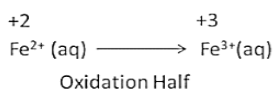
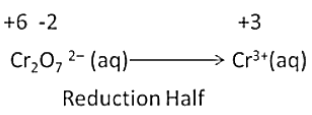
Fe2+ + Cr2O72- → Fe3+ + Cr3+
Oxidation half reaction is-
Reduction half reaction is-
Use the reduction half method to balance the equation. Balance the atoms in each half of the reaction except H and O atoms.
Cr2O72- (aq) → 2 Cr3+(aq)
Add water molecules as the reaction is taking place in acidic solution. This is to balance the O atoms and hydrogen ions.
Cr2O72- (aq) + 14 H+(aq) → 2 Cr3+(aq) + 7H2O (I)
Then balance the charges in both half reactions.
Fe2+(aq) → Fe3+(aq) + e-
Cr2O72- (aq) + 14 H+ + 6e- → 2 Cr3+ + 7H2O
6 Fe2+(aq) → 6 Fe3+(aq) + 6e-
Two half of the equations are added to get the overall reaction
6Fe2+(aq) + Cr2O72-(aq) + 14H+(aq) → 6Fe3+(aq) + 2Cr3+(aq) + 7H2O (I)
Unbalanced Chemical Equation: If the number of atoms of each element in reactants is not equal to the number of atoms of each element present in the product, then the chemical equation is called Unbalanced Chemical Equation.
Example: Fe + H2O → Fe3O4 + H2
In this example, a number of atoms of elements are not equal on two sides of the reaction. For example; on the left-hand side only one iron atom is present, while three iron atoms are present on the right-hand side. Therefore, it is an unbalanced chemical equation.
Balancing a Chemical Equation: To balance the given or any chemical equation, follow these steps:
Fe + H2O → Fe3O4 + H2
The basic ionic form of the equation is-
Fe2+ + Cr2O72- → Fe3+ + Cr3+
Oxidation half reaction is-
Reduction half reaction is-
Use the reduction half method to balance the equation. Balance the atoms in each half of the reaction except H and O atoms.
Cr2O72- (aq) → 2 Cr3+(aq)
Add water molecules as the reaction is taking place in acidic solution. This is to balance the O atoms and hydrogen ions.
Cr2O72- (aq) + 14 H+(aq) → 2 Cr3+(aq) + 7H2O (I)
Then balance the charges in both half reactions.
Fe2+(aq) → Fe3+(aq) + e-
Cr2O72- (aq) + 14 H+ + 6e- → 2 Cr3+ + 7H2O
6 Fe2+(aq) → 6 Fe3+(aq) + 6e-
Two half of the equations are added to get the overall reaction
6Fe2+(aq) + Cr2O72-(aq) + 14H+(aq) → 6Fe3+(aq) + 2Cr3+(aq) + 7H2O (I)
Unbalanced Chemical Equation: If the number of atoms of each element in reactants is not equal to the number of atoms of each element present in the product, then the chemical equation is called Unbalanced Chemical Equation.
Example: Fe + H2O → Fe3O4 + H2
In this example, a number of atoms of elements are not equal on two sides of the reaction. For example; on the left-hand side only one iron atom is present, while three iron atoms are present on the right-hand side. Therefore, it is an unbalanced chemical equation.Balancing a Chemical Equation: To balance the given or any chemical equation, follow these steps:
Fe + H2O → Fe3O4 + H2
To Make Equations More Informative:
Writing the symbols of physical states of substances in a chemical equation:
By writing the physical states of substances, a chemical equation becomes more informative.
- Gaseous state is represented by symbol (g).
- Liquid state is represented by symbol (l).
- Solid state is written by symbol (s).
- Aqueous solution is written by symbol (aq).
- Writing the condition in which reaction takes place: The condition is generally written above and/or below the arrow of a chemical equation.
Thus, by writing the symbols of the physical state of substances and condition under which reaction takes place, a chemical equation can be made more informative.
Skeletal chemical equation: A chemical equation which simply represents the symbols and formulas of reactants and products taking part in the reaction is known as skeletal chemical equation for a reaction.
Types of chemical reactions
● Decomposition
● Single Displacement
● Double displacement
● Redox
● Endothermic
● Exothermic
● Precipitation
● Neutralisation
BEST NO ONE COMPETE WITH YOU
ReplyDeleteThank you for sharing such a good informative post. top cbse school in gurgaon
ReplyDelete